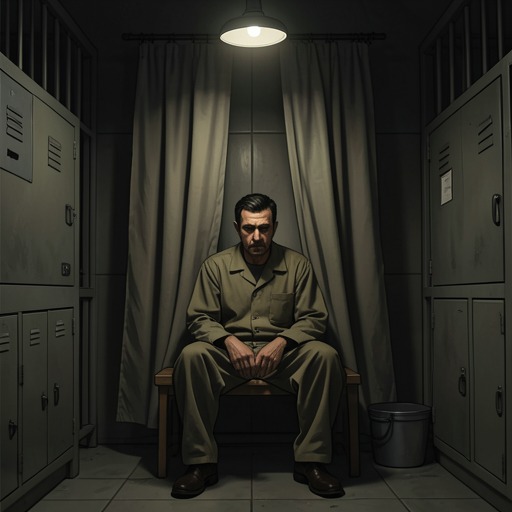
Caspar Leinen
The Collini CaseCaspar Leinen’s first major trial makes his professional debut inseparable from a larger question: how the law can close an investigation without settling the guilt or history behind it. Appointed to defend Fabrizio Collini, Leinen begins by checking whether his friendship with the Meyer family presents a conflict; in court, he later shows that Collini himself had reported Hans Meyer, only for the investigation to be discontinued under a limitation rule that took effect in 1968.
Identity and Early Career
Leinen is a young defense lawyer at the start of his career. He had qualified forty-two days before Collini’s case came to him. After completing his second state law examination, he took a gap year and travelled through Africa and Europe, often staying with old friends from boarding school. His new practice was in two rooms at the rear of a building in a side street off the Kurfürstendamm. A nameplate announcing Caspar Leinen, Legal Adviser, had gone up only days earlier; he found it rather ostentatious, but liked it all the same.
His independence was real but modest in scale. The office had no lift, its visitors’ chairs came from a flea market, and the metal filing cabinet was empty. The desk was a present from his father. On the Sunday morning of his first assignment, Leinen had spent hours sorting through the office and was still surrounded by open boxes. These details place his professional confidence alongside the material incompleteness of a practice just begun.
Appointment and Client
Like many young defense lawyers, Leinen had put his name on the legal-aid rota. Lawyers on weekend standby carried mobiles so police, prosecutors, and magistrates could reach them when an arrested person requested representation. Such appointments often provided young counsel with their first briefs. Leinen’s first call came from an examining magistrate at Tiergarten District Court: a suspect had no representative, and prosecutors were seeking an arrest warrant on a murder charge. Leinen said he could arrive in about twenty-five minutes and hurried over with his new robe packed in his briefcase.
The assignment brought him into the case of Fabrizio Collini, a client whose circumstances immediately met Leinen’s professional role with a personal complication. In their interview, Leinen told Collini about his friendship with the Meyer family and asked whether that connection troubled him. Collini answered that it did not: Hans Meyer was dead, and he was no longer interested in the friendship. The exchange establishes that Leinen does not conceal the potential conflict from his client; he raises it directly before proceeding.
The First Major Trial
At trial, Leinen faced Richard Mattinger, a seasoned opponent who shaped the early proceedings through careful presentation of the forensic evidence. During the first five days, witnesses and experts repeated evidence already given to police. Mattinger questioned Professor Wagenstett about the shooting, the physical evidence, and the sequence of events, pressing him to explain technical terms in plain language. The presentation gave the court a forceful account of the killing, while Leinen watched the lay judges’ response and saw how powerfully the images and explanations could fix an interpretation in their minds.
Leinen’s own first major address took a markedly different form. Before speaking, he drank water and looked toward Johanna Meyer; he had warned her the previous day that the session would be terrible for her, but believed there was no alternative. He then stood calmly at the lectern and read slowly and softly, relying on what Collini had told him and on material he had found in the files in Ludwigsburg. The legal language did not remain abstract in the courtroom: as he set out the account sentence by sentence, listeners began to picture the people and places it described. The scene marks a change in Leinen’s understanding of advocacy. He had studied law and criminal procedure, but in making this plea he recognized that proceedings were also about human beings who had been abused.
The Investigation and the Limitation Rule
The decisive turn in Leinen’s cross-examination came after Dr Sybille Schwan confirmed that the proceedings against Hans Meyer had been discontinued. Richard Mattinger had established that the Stuttgart Public Prosecutor’s Office opened an investigation, but that Meyer was neither questioned nor charged. When Dr Schwan confirmed that the investigation was dropped on 7 July 1969, Mattinger ended his questioning. The moment appeared to settle the courtroom’s account of Meyer: Mattinger had, in the narrator’s words, won, and Meyer was no longer treated as a murderer.
Leinen reopened the issue by asking who had brought the accusation against Hans Meyer. Dr Schwan identified Collini as the complainant. The answer startled the court; no one had known it, and Mattinger’s face paled. Leinen then drew out what the earlier discontinuance meant: Collini had named the man responsible for his father’s death, supplied what evidence he had, and trusted the authorities, but received a letter saying the proceedings had ended because the matter was subject to a statute of limitations. Dr Schwan confirmed that the relevant rule followed a law which came into force on 1 October 1968.
Mattinger objected that the case was becoming a history lecture and argued that the court was trying the defendant, not the legislators. Leinen answered that the history mattered to guilt because it bore on whether Collini’s act was arbitrary or understandable. The presiding judge allowed the inquiry on the ground that it could affect the assessment of motive. The exchange shows Leinen redirecting the trial without denying the killing: he insists that the legal and historical circumstances can matter to how the act is judged.
Advocacy and Narrative Significance
Leinen’s questioning exposes a gap between procedural closure and a resolved account of responsibility. The investigation into Hans Meyer was discontinued, and Dr Schwan confirmed that the guilt or innocence underlying it was not pursued further. When Leinen asks whether the law could simply be repealed, the answer is that the rule-of-law principle prevents reversing a limitation ruling once an offence has become time-barred. He then takes a grey volume of legal commentary from the judges’ table and asks whether its author, Dr Eduard Dreher, is the same Dreher associated with the widely used criminal-law commentary. Dr Schwan confirms that Dreher co-authored it. Leinen lets the volume fall back onto the table and sits down, turning a familiar professional reference into a pointed question about the law’s institutional history.
The novel’s account of Leinen’s work is therefore also an account of competing ways to tell a case. Mattinger makes the physical evidence legible as a prosecution narrative; Leinen uses the case files and Collini’s account to bring the discontinued investigation into the courtroom. His advocacy does not erase the fact that Collini killed Hans Meyer. Instead, it challenges the assumption that a formally closed proceeding has exhausted the questions of motive and responsibility. The novel’s concern with that institutional past extended beyond its courtroom plot: in January 2012, a few months after its original German publication, the Federal Minister of Justice appointed a committee to reassess the Ministry’s Nazi-era legacy, and the novel was among its points of reference.